|
Village War Years
by Ray Reeks. |
Talk of village life in war years, evokes memories
and stories of local heroism and humour galore. Much of the
kaleidoscope of life in those days is measured through the
minds of those who were either school children (of which I
was one) or young adults.
Many rural families were self reliant as far as
basic needs were concerned, having gardens, small holdings
and farms to supplement rationed foods. It was from this
background that the local militiamen came. They helped to
man the Home Guard, the ARP and other back- up units, whilst
others were called up to join the forces.
Mr George Bailey, our informant on Home Guard
affairs, says that until a year or so had elapsed since the
outbrcak of war in September 1939, Dad's Army was probably a
good term to use to describe the gallant efforts of this
fine body of men. Up until this time pitchforks from the
hayloft, rabbiters' shotguns and any other hatchet type
tools to be found in the average woodshed had to suffice as
defensive weapons in the guarding of strategic points, eg
rail and road bridges and checkpoints at the entrances to
the village.
As often happens, to alleviate fear and
uncertainty, wit and humour blossomed, stories appearing in
night duly reports, for instance, noted a suspected enemy
submarine spotted off
Potteme
Bridge
. A short-sighted Private Brewer on point duty at Crab
Orchard invited a 'Halt! who goes there?' suspect to "Hang on
yer to me rifle a minute, while I get me glasses out'!
Officers of the ranks, too, were not without their
moments — Lt. Jack Sherry naturally wanting a 'good show'
on the auspicious occasion of Top Brass dropping in, readily
agreed to administer' spit and polish' and Brasso to buttons
on the uniform of a recalcitrant colleague. I'll bet they
all cottoned on to that one eventually if the truth got out!
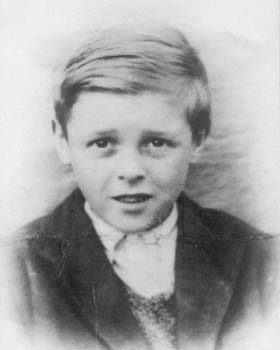 Max Barrett
who at 14 years old, was the
only Civilian Casualty in Verwood during
the Second World War, lived in Hillside Road and
was the 2nd son of Ena. (ne: Atyeo) and Norman
Barrett. During the Spring of 1944 he was in bed
with his elder brother Roy when an Incendiary came
through the roof and killed him leaving his
brother, sleeping in the same bedroom, unharmed.
It is understood that his body was taken to the
room above the Crossroads Pottery where it was
laidout. At that time the room was used by
Verwood Scouts. He is survived by 1
brother and 3 sisters (in 2007). Max Barrett
who at 14 years old, was the
only Civilian Casualty in Verwood during
the Second World War, lived in Hillside Road and
was the 2nd son of Ena. (ne: Atyeo) and Norman
Barrett. During the Spring of 1944 he was in bed
with his elder brother Roy when an Incendiary came
through the roof and killed him leaving his
brother, sleeping in the same bedroom, unharmed.
It is understood that his body was taken to the
room above the Crossroads Pottery where it was
laidout. At that time the room was used by
Verwood Scouts. He is survived by 1
brother and 3 sisters (in 2007).
|
The ARP patrol (Air Raid Precautions) played an
important part too, being in line with the coastal approach
of enemy aircraft making for industrial targets in the
Midlands
, often planes were flying over Verwood. Incendiary devices
etc were often ditched in this area. In fact it was such a
bomb falling onto a bungalow in
Hillside Road
that caused the only fatality in Verwood, namely that of
fourteen year old Max Barrett. As fellow school pupils and
scout members, I remember, we threw posies of primroses into
the grave, it being the spring of '44.
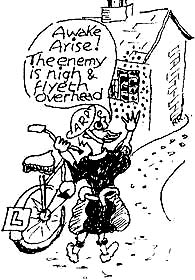 The
ARP Headquarters was at the "Restyng House", which
has since been demolished and was where the new Bailey's
complex now stands. Mrs Christine Stratton. as a young
teenager along with others, says there were creepy rides,
often in pitch black, as they cycled with messages to
outlying wardens. My father, Mr Tony Reeks, being the warden
for Romford also received messages from the Rev. John Lynes,
at that time Vicar of Verwood Who would arrive and throw
gravel up to my parents' bedroom window to wake my father
for duty. The
ARP Headquarters was at the "Restyng House", which
has since been demolished and was where the new Bailey's
complex now stands. Mrs Christine Stratton. as a young
teenager along with others, says there were creepy rides,
often in pitch black, as they cycled with messages to
outlying wardens. My father, Mr Tony Reeks, being the warden
for Romford also received messages from the Rev. John Lynes,
at that time Vicar of Verwood Who would arrive and throw
gravel up to my parents' bedroom window to wake my father
for duty.
Air raid shelters came in a variety of types. When
at school we would be hastily marched across to a long
trench dug in the grounds of the Vicarage, (now Montrose)
when the siren blew. At home a dug-out in a large ditch with
water running under the floor, which was made of old chicken
houses, served three families. The roof wasof corrugated
iron and was packed with earth clods. Whilst in residence we
shared safety with snails, mice and all sorts of creepy
crawl ies.
As youngsters there was novelty about much that
occured for the war effort, as with picking and collecting
of hundredweights of blackberries, hips from the hedgerows
and acorns for the pigs. There were excited excursions on
bikes to see the occasional aircraft crash out in the
country, most notably a Luftwaffe Focke shot down on the
Edmondsham Road
, near Birches Copse. The scene was visited next day by the
fighter pilot, 'Cat's Eyes' Cunningham, who after the war
was to become the chief test pilot for De Havilland.
Shattered Perspex from cockpit canopies was prized loot from
which finger rings could be cut, a small gem stone placed in
the centre.. a hit with the girl friends.
|